Construction Notices: Why Early Warning Shouldn’t Mean a Claim Is Coming
A notice doesn't have to mean a claim is coming. Why sending it early, with strong records behind it, protects both sides of a construction contract.
.png)
.png)
A guide to selecting construction project documentation software that captures site activity as it happens and remains reliable when projects come under commercial pressure.

Construction project documentation software captures, organises, and retrieves site records as work progresses on a construction project. Its value depends on how closely it reflects site activity, particularly when projects face delays, changes, or commercial pressure.
Construction teams generate large volumes of information every day. Daily reports, site diaries, photos, emails, instructions, and messages form part of normal delivery. The challenge lies in capturing this information at the right time, storing it in a usable format, and relying on it later when decisions need to be made.
This guide explains how to choose construction project documentation software based on how site teams operate on live projects.
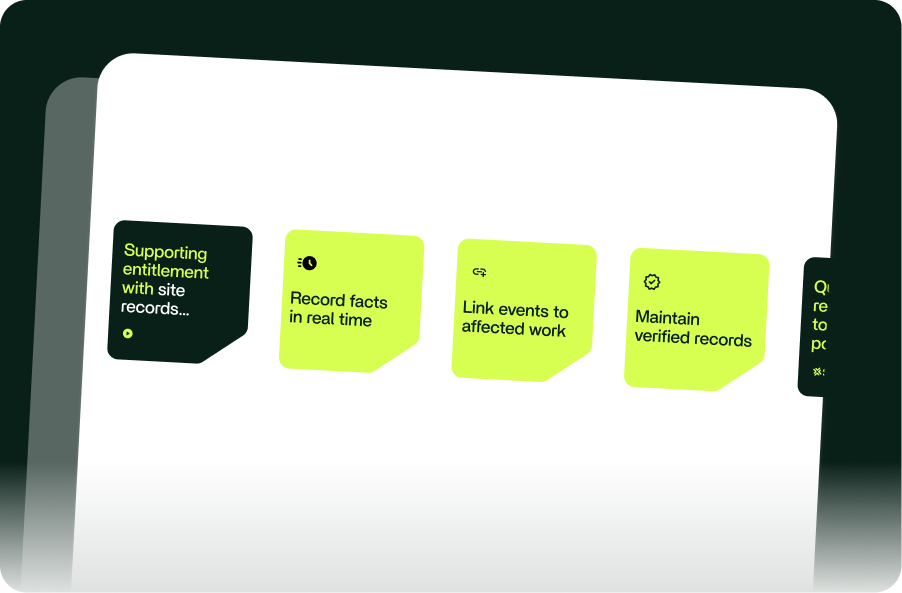
On live projects, documentation software is typically relied on to:
The most effective systems are designed around site behaviour first, with reporting and governance built on top of that foundation.
Most documentation failures come down to three issues:
Traditional site diaries are often completed at the end of the day. Informal instructions are buried in messages or conversations. Photos are saved without context. When variations, delays, or commercial issues arise, teams are forced to rebuild timelines under pressure.
Good documentation software reduces this reconstruction work by capturing site events early and preserving it accurately.
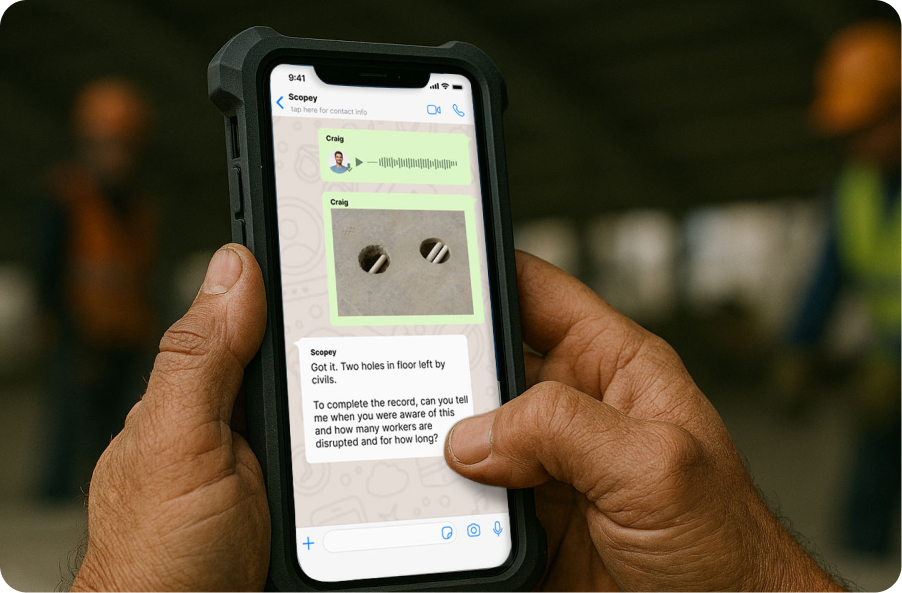
The most important assessment criterion is how easily site teams can record information while work is happening.
If a system relies on complex forms, rigid workflows, or end-of-day reporting, information will be missed. Effective tools fit naturally into site routines and allow supervisors to record events quickly without interrupting the job.
Documentation only has value if it is contemporaneous.
Strong systems automatically timestamp entries and preserve original records. Tools that rely on manual editing or retrospective uploads introduce risk, particularly when documentation is later relied upon to support change control, variations, or extension of time discussions.
Construction issues rarely exist in isolation. A single change may involve multiple photos, instructions, conversations, and site activities over several days.
Documentation software should allow related records to be grouped and reviewed together. If information cannot be linked, it cannot be relied upon during commercial discussions.
Documentation systems should support contract administration, not sit outside it.
This often means supporting change control and programme impacts, and a reliable audit trail is worth it’s weight in gold.
Software that simply stores documents without context often fails when commercial pressure increases.
The real test of documentation software is how it supports the business when projects are delayed, variations are disputed, or deadlines are tight.
If a system cannot quickly produce a clear and accurate timeline of events, it will be of little help to project managers, commercial managers, or quantity surveyors when it matters most.
Many documentation platforms are now adding AI features, which is useful in limited but important areas.
AI adds value when it is used to organise unstructured site data. This includes transcribing voice notes, classifying photos and messages, grouping related site events, and improving search across large project records. It can also support visual data at scale, such as tagging site photos, reviewing drone imagery, or aligning images with digital models to identify changes over time, while leaving engineering and commercial judgement with the project team.
AI is far less reliable when it is positioned as a decision-maker. Automatically assessing contractual entitlement, responsibility for delays, or interpreting contract clauses introduces risk. Construction projects are governed by contracts and context, not patterns alone.
The quality of data matters more than the sophistication of AI. If site records are incomplete or retrospective, AI will simply process poor information faster.
When assessing whether AI will positively impact your construction project, consider this: Can outputs be traced back to original records?
When implemented properly, construction project documentation software helps teams:
There is a wealth of data in construction, so the goal should be to ensure it serves the business by capturing and structuring it effectively.

Developed alongside forward-thinking construction teams and project leaders who want to simplify reporting, strengthen compliance, and stay ahead of risk.
Let’s talk.

Commercial intelligence for complex construction projects.
©2026 Scopey Onsite. All rights reserved.