Construction Notices: Why Early Warning Shouldn’t Mean a Claim Is Coming
A notice doesn't have to mean a claim is coming. Why sending it early, with strong records behind it, protects both sides of a construction contract.
.png)

Construction variations often start informally and go unmanaged until it is too late; this article explains how accurate site records help identify changes early and reduce commercial risk.

Construction variations are one of the most common sources of commercial friction on building and infrastructure projects. They are also one of the most poorly documented.
In theory, variations follow a clear process. In practice, many start as informal instructions, site discussions, or minor changes that accumulate over time. By the time they are reviewed commercially, the records are often incomplete or disputed.
This page explains how accurate site records support better change management, earlier decision-making, and stronger commercial outcomes.
A construction variation is any change to the original scope of works, whether to design, sequence, method, or quantity. While contracts define variations formally, most projects experience them informally first.
Common examples include:
The challenge is not identifying variations after the fact. The challenge is recognising them early, while the project still has options.
On many projects, variation identification depends on retrospective reporting. Site diaries are completed after the fact. Instructions are buried in messages. Photos are stored without context. Commercial teams often see changes weeks after they occurred.
By the time issues are reviewed, notice deadlines may already be missed and positions may have hardened. What could have been managed early becomes a dispute that is harder to resolve.
Late identification does not just increase commercial risk. It also damages trust between site and commercial teams.
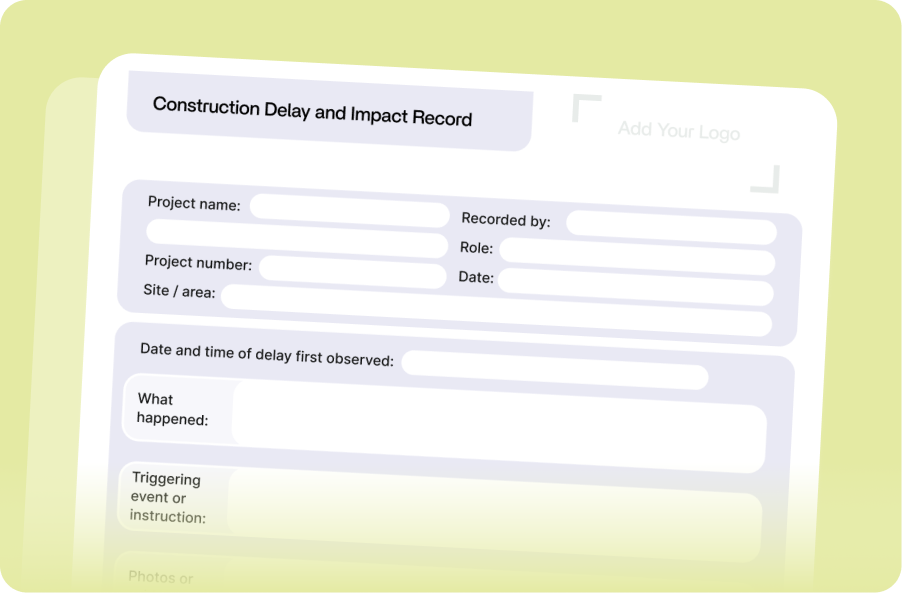
Site records provide the evidence needed to show what changed, when it changed, and why it changed. They support discussions about entitlement, timing, and impact before positions harden.
Good site records typically include:
Without this foundation, variation discussions rely on memory and interpretation rather than fact.
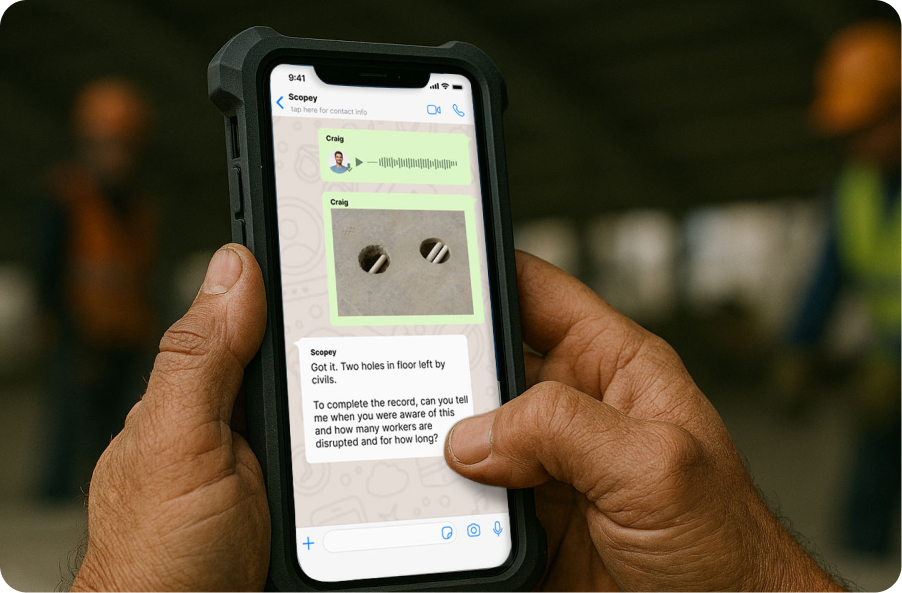
Informal instructions are a normal part of construction. Supervisors and engineers issue directions verbally to keep work moving. The risk arises when those instructions are not recorded at the time they are given.
When informal instructions are not documented, intent becomes unclear and timing is disputed. Commercial teams struggle to assess entitlement or impact, not because the change did not occur, but because the record is weak.
Capturing informal instructions contemporaneously does not slow projects down. It reduces ambiguity and allows early decisions about whether formal notice or pricing is required.
Variations rarely exist in isolation. A single change can affect multiple trades, activities, or programme milestones.
Effective documentation allows site records to be linked across:
This linkage is critical. Minor changes that appear insignificant on their own often have material consequences when viewed together over time.
While contract forms differ, the underlying challenges are similar across projects.
Variation and change management may be framed through formal change control, programme impacts, or contractual entitlement, but the requirement is the same. Clear, accurate records that reflect what actually happened on site.
Strong documentation supports better conversations between site teams, commercial managers, and quantity surveyors, regardless of the contract form in use.
Variation disputes tend to escalate for predictable reasons. Records are incomplete, timelines are unclear, instructions cannot be traced, and impacts are difficult to quantify.
When documentation is weak, discussions move away from facts and towards positions. This increases the likelihood of rejection, delay, or escalation.
Better site records do not remove disagreement, but they reduce uncertainty and support earlier resolution.
When variations are identified and documented early, project teams are better placed to issue timely notices, assess impact while work is ongoing, and prioritise commercially significant changes.
The objective of variation documentation is not to generate claims. It is to manage change before it becomes a dispute.

Developed alongside forward-thinking construction teams and project leaders who want to simplify reporting, strengthen compliance, and stay ahead of risk.
Let’s talk.

Commercial intelligence for complex construction projects.
©2026 Scopey Onsite. All rights reserved.





.png)