Construction Notices: Why Early Warning Shouldn’t Mean a Claim Is Coming
A notice doesn't have to mean a claim is coming. Why sending it early, with strong records behind it, protects both sides of a construction contract.
.png)
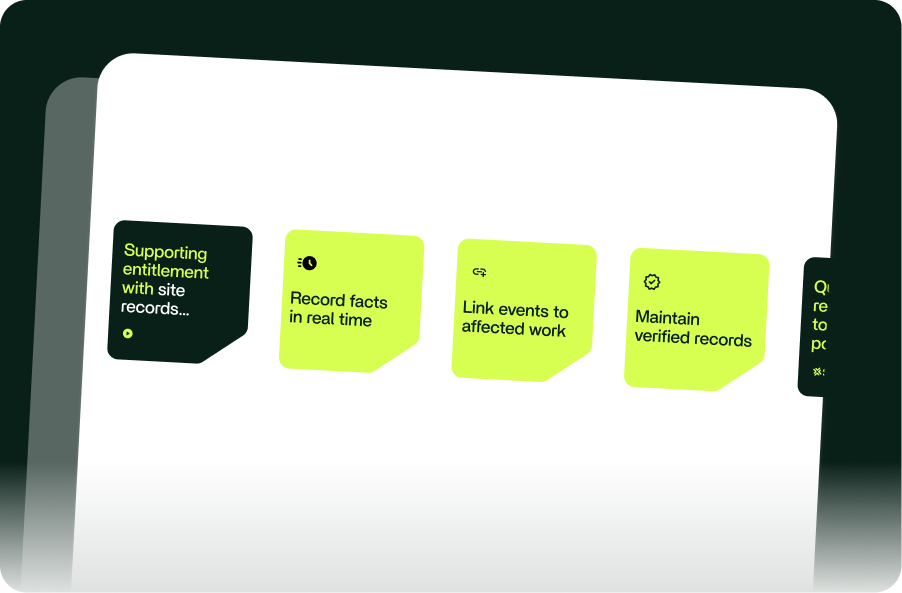
What needs to be recorded on site, when it needs to be captured, and where positions typically weaken.

Disruption and delay is part of most projects. Access constraints, late information, sequencing changes and coordination issues all affect how work is carried out.
What matters commercially is whether those events are recorded in a way that shows how progress was affected and can be relied upon later in conjunction with the contract and programme.
When entitlement is reviewed, the position is supported or weakened by the records available. Programme movement on its own is rarely sufficient without supporting records: The focus is on what was recorded at the time work was delayed/disrupted.
This article looks at how site records support entitlement to time and where that position typically weakens.
Entitlement to time relies on records that show both the delay event and its effect on progress.
Positions tend to weaken where:
At that point, the link between the delay event or circumstance, and the impact “cause and effect” becomes difficult to demonstrate.
Programmes show that dates have changed. They do not usually explain why.
When entitlement is assessed, that explanation needs to come from site records. Without it, the connection between the delay event and programme impact is incomplete.
The strength of the position largely depends on what was recorded on site at the time work was affected.
Records created at the time of the event are more likely to be relied on because they reflect site conditions as they were understood then. Even better, if verified by both parties to the Contract.
Effective records:
They do not need to quantify delay at that stage. Their role is to establish a clear factual record of the actual event or circumstance.
While time impacts can come from a single event, sometimes they are compounded through a series of disruption events leading to a delay event. Disruption as distinct to delay can be difficult to prove.
That’s why records are most powerful when they allow those events to be linked across time, showing how activities were affected and how the impact(s) developed. This becomes important where multiple factors are involved or where responsibility is disputed, where clear apportionment of the cause and effect may be unknown, or disputed between the parties to a contract/agreement.
Notice provisions typically require the disruption and/or delay event to be identified early.
Where events are not captured at site level, escalation tends to happen late. Notice is then issued outside the required timeframe, which may affect the claims entitlement.
Site records give early visibility of the delay event and support issuing notice within the contractual window.
Site records support entitlement by:
The aim is to maintain a position that holds up under review, based on what was recorded at the time.
Maintaining a defensible position comes down to the quality and timing of site records. When disruption is captured clearly as it occurs, and linked to how work was affected, the position is easier to support later.
We are focused on helping construction teams put simple, consistent processes in place so that site information can be relied on when it is needed.
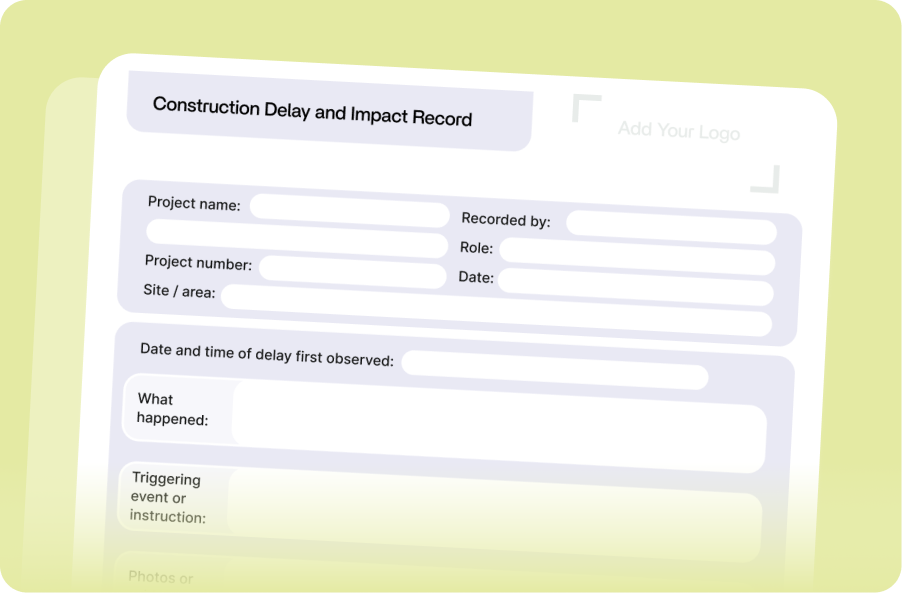
For a practical guide, refer to the reference sheet outlining the key details to record when disruption and delay occurs, along with guidance for capturing this information under live site conditions.

Developed alongside forward-thinking construction teams and project leaders who want to simplify reporting, strengthen compliance, and stay ahead of risk.
Let’s talk.

Commercial intelligence for complex construction projects.
©2026 Scopey Onsite. All rights reserved.







.png)