Construction Notices: Why Early Warning Shouldn’t Mean a Claim Is Coming
A notice doesn't have to mean a claim is coming. Why sending it early, with strong records behind it, protects both sides of a construction contract.
.png)
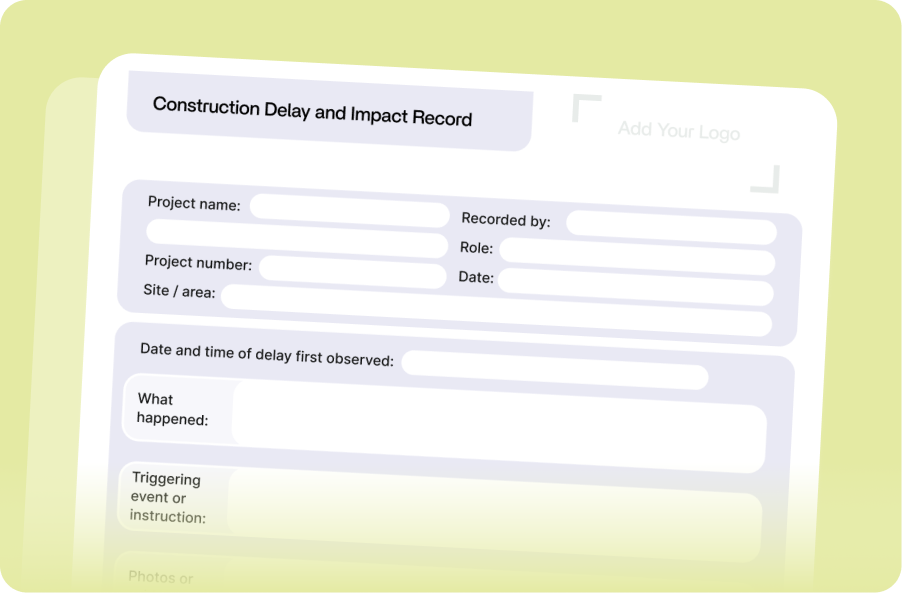
Key information to capture when documenting construction delays and extension of time events.

Delays rarely start as formal claims or programme issues. They begin on site, often as small interruptions to planned work that seem manageable at the time. When those interruptions are not recorded clearly as they occur, teams are left trying to reconstruct events later, which weakens the ability to support entitlement when the delay is assessed.
This reference sheet sets out the key details that should be captured when work is delayed, along with practical guidance on when and how to record them under live site conditions. It provides a consistent standard for capturing delay events early, so records can be relied on when entitlement is reviewed. A shared standard for recording delay events early, will mean project and commercial teams have a reliable record to work from as the project progresses.
Capturing this information consistently on a live site is difficult.
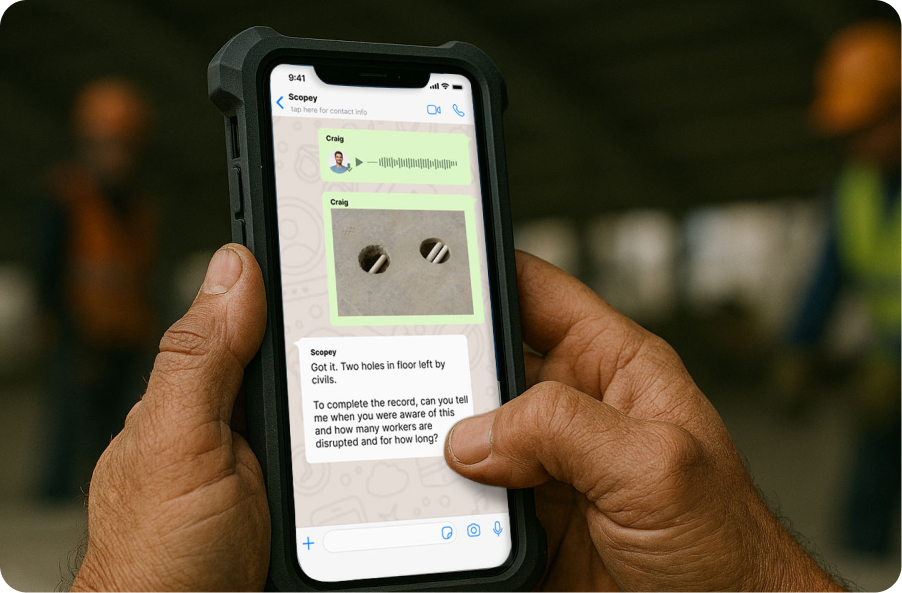
Scopey Onsite is built to help site teams capture these records as work happens, using simple messages, photos, and voice notes, without changing how they already operate. The result is a consistent, time-stamped record of site events that can be relied on to support entitlement.
If you would like to see whether Scopey could work for your team, you can book a short demo to walk through how it is used on site.

Developed alongside forward-thinking construction teams and project leaders who want to simplify reporting, strengthen compliance, and stay ahead of risk.
Let’s talk.

Commercial intelligence for complex construction projects.
©2026 Scopey Onsite. All rights reserved.






.png)